Ask today’s AI a question about a 100,000-word document and it makes around ten billion internal comparisons – a big reason the cost and energy behind AI are spiralling. Inspired by the human brain, Melbourne-based i14 has developed an entirely new kind of AI model that runs at a fraction of the memory, cost and energy of today’s systems.
We are excited to announce our investment in i14, a foundation AI model developer spun out of the University of Melbourne. Our commitment, made from our second fund, forms part of the company’s A$9m seed round.
AI’s power problem
Virtually every major AI model today – ChatGPT, Claude, Gemini – runs on the same “transformer” architecture, which compares every word in a passage against every other word. It is remarkably capable, but the cost grows quadratically as prompts get longer: doubling the input quadruples the work, and long documents can require multiple high-end GPUs costing tens of thousands of dollars each. These are fundamental limits of the architecture, not bugs to be engineered away – and they are why the leading AI labs are currently deeply loss-making at scale – and compute is so scarce.
i14’s solution: performance parity at a fraction of the cost
i14’s Laplace Sequence Model (LSM) takes a fundamentally different approach. Developed over three decades by co-founder Professor Simon Dennis, it mimics how the human brain compresses and retrieves memories, storing the gist of what came before rather than an exact record of every word. The result is a fixed memory footprint up to dozens of times smaller than a comparable transformer – and a flat cost per word no matter how long the context grows. In early testing, i14’s 1 trillion parameter model achieves performance parity with comparable models, using a fraction of the compute and energy.
A team with 30 years of research heritage
As compelling as the early results are, it is the calibre of the team that excites us most. i14 brings together a rare blend of world-leading cognitive science and hard-won commercial experience – people with both the depth to reinvent how AI works and the drive to turn that science into a product.
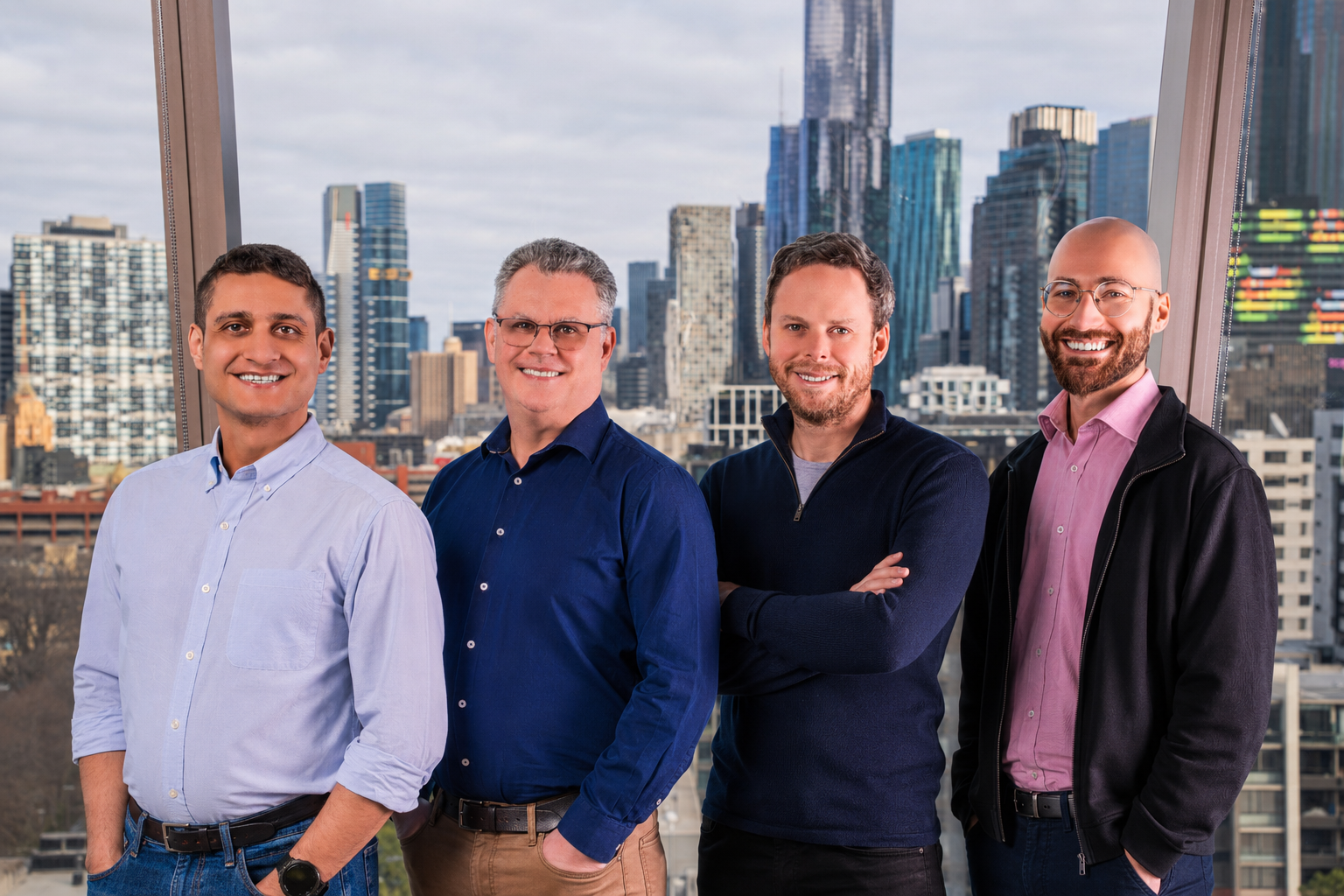
Simon Dennis (Co-Founder & CSO) is a cognitive scientist who has spent 30 years building computational models of human memory, first implementing a neural network in an AI model back in 1993. The LSM is the culmination of his life’s work.
Tom Mcleod (Co-Founder & CEO) is a two-time software founder with a Masters in natural language processing.
Michael Diamond (Co-Founder) brings experience across cognitive science, data science and applied AI, helping translate i14’s research into practical AI systems.
Kevin Shabahang (VP AI Research) completed his PhD in language modelling under Simon’s supervision and was previously co-founder and CTO of legal-tech company Time Credit AI, which was recently acquired.
David v Goliath
i14 is up against the world’s best-funded companies, and the risks are real: no new architecture has yet proven itself at the very frontier, and the incumbents have vastly more capital. But i14 doesn’t need to out-spend them. By turbo-charging existing models, it inherits billions of dollars of prior training while slashing the cost of running them. Furthermore, its approach is novel and hard to copy. The LSM rests on Simon’s 30-year research lineage. An independent review found i14’s to be the only alternative architecture combining an unbounded context window, flat compute cost and the potential for strong performance at scale.
With chips and power now limiting the AI build-out, and the economics of frontier AI facing an unavoidable reckoning, we believe i14 – which gets multiples more out of every GPU – has the potential to reshape how AI is built and run.
For further details or any questions, please reach out to Alex Oppes.
You can also read more about i14 on AWS’s Blog.